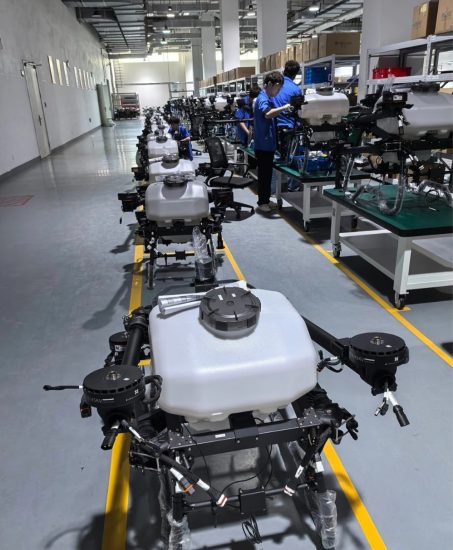


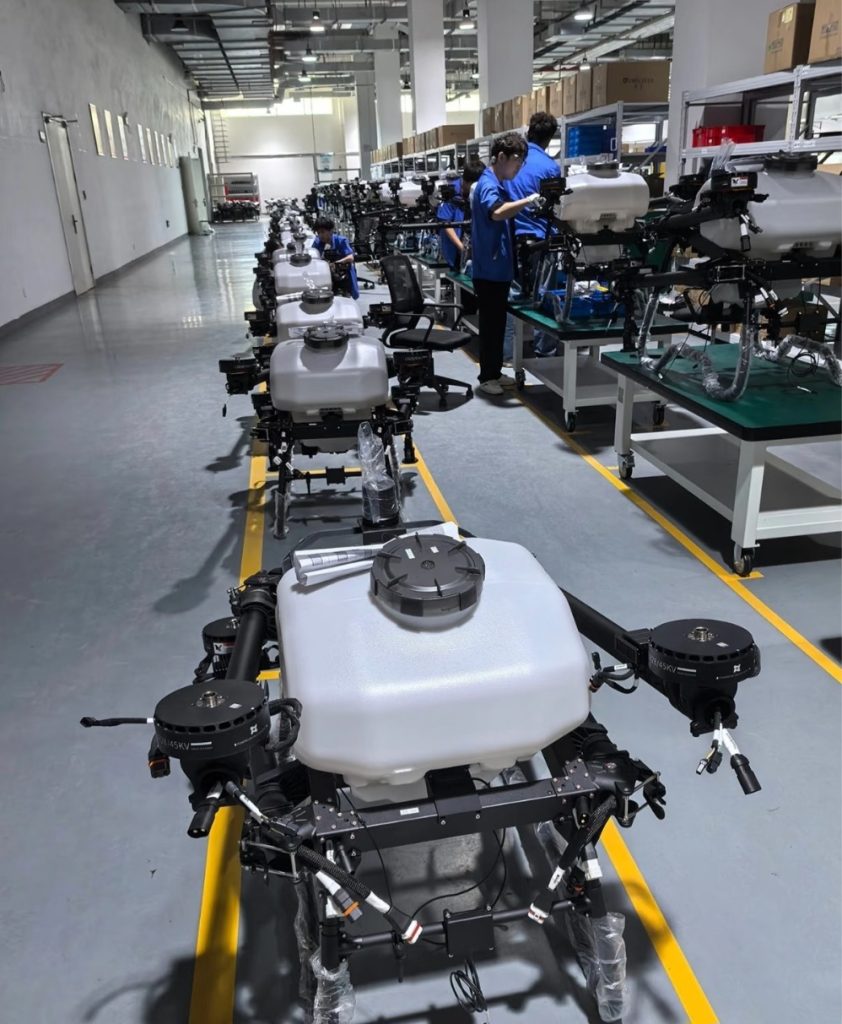
One of the most common questions from farmers, agricultural contractors, and agricultural drone buyers is: How many acres can an agricultural spraying drone cover per hour?
There is no single answer because actual productivity depends on many factors, including drone payload capacity, spray width, flight speed, application rate, battery endurance, field layout, refill time, weather conditions, and operator experience.
A drone may have a theoretical working capacity of hundreds of acres per day, but its real-world productivity can be significantly different.
This guide explains how to estimate agricultural spraying drone productivity and which factors have the greatest impact on field efficiency.
1. The Difference Between Theoretical and Real Productivity
Agricultural drone manufacturers often provide a maximum operating efficiency figure based on controlled conditions.
However, field operations include many additional activities:
-
Flying to the working area
-
Loading agricultural chemicals
-
Refilling the tank
-
Changing batteries
-
Returning to the charging area
-
Turning at field boundaries
-
Avoiding obstacles
-
Adjusting routes
-
Dealing with uneven terrain
-
Managing weather conditions
For this reason, buyers should distinguish between theoretical spraying capacity and actual field productivity.
For example, a drone may have a high spraying rate under ideal conditions, but its daily output can decrease if the farm has small fields, many obstacles, long distances between refill points, or difficult terrain.
2. What Determines How Many Acres a Drone Can Spray?
Several specifications directly affect agricultural drone productivity.
Payload Capacity
A larger spray tank means the drone can carry more liquid before returning for a refill.
If the application rate is fixed, increasing tank capacity can reduce the number of refills required.
For example, if a drone carries 20 liters and the application rate is 10 liters per hectare, one full tank theoretically covers 2 hectares.
If another drone carries 40 liters under the same application conditions, it can theoretically cover 4 hectares per tank.
However, a larger payload also increases the drone’s weight and energy consumption, so payload capacity should be evaluated together with battery performance.
Spray Width
Spray width has a major influence on productivity.
A wider effective spray width allows the drone to cover more ground during each flight pass.
However, buyers should not rely only on the manufacturer’s maximum advertised width.
Actual coverage depends on:
-
Nozzle configuration
-
Droplet size
-
Flight altitude
-
Crop characteristics
-
Wind speed
-
Chemical application requirements
-
Required overlap
The effective spray width is more useful than the theoretical maximum width.
Flight Speed
Higher flight speed can increase theoretical area coverage, but speed must be compatible with the spraying system.
If the drone flies too quickly, spray coverage may become inconsistent.
Flight speed should therefore be optimized together with:
-
Spray flow
-
Nozzle output
-
Spray width
-
Application rate
-
Crop type
-
Wind conditions
The goal is not simply to fly faster, but to maintain the required application quality while achieving good productivity.
3. Application Rate Has a Major Impact
Application rate determines how much liquid is required per unit of farmland.
For example, suppose a drone has a 30-liter tank.
If the application rate is 10 liters per hectare:
30 ÷ 10 = 3 hectares per tank
If the application rate increases to 20 liters per hectare:
30 ÷ 20 = 1.5 hectares per tank
The same drone therefore covers very different areas per tank depending on the application rate.
This is why manufacturers should avoid giving a single productivity number without explaining the operating conditions.
4. A Simple Productivity Calculation
A basic theoretical calculation can be made using:
Area per hour = Spray width × Flight speed × Time
The result must be converted into the required agricultural area unit.
For example, assume a drone operates with:
-
Effective spray width: 6 meters
-
Flight speed: 5 meters per second
The theoretical ground coverage is:
6 × 5 = 30 square meters per second
In one hour:
30 × 3,600 = 108,000 square meters
Since 1 hectare equals 10,000 square meters:
108,000 ÷ 10,000 = 10.8 hectares per hour
This is a theoretical coverage figure.
It does not mean the drone will necessarily spray 10.8 hectares of farmland every hour because it does not include refilling, turning, battery changes, transportation, obstacles, and other operational downtime.
5. Why Real Productivity Is Lower
Real-world productivity is usually lower than theoretical flight coverage.
Consider a typical operation:
-
40 minutes of actual spraying
-
5 minutes of turning and repositioning
-
5 minutes of refilling
-
10 minutes for battery replacement and other operations
Only part of the hour is spent actively spraying.
This is why professional buyers should ask manufacturers for effective hourly productivity rather than only maximum flight speed or theoretical coverage.
6. Battery Capacity and Charging Time
Battery management can significantly affect daily output.
If a drone requires frequent charging and the charging process is slow, the operator may spend substantial time waiting.
A professional operation may use multiple batteries.
For example:
-
Battery A is being used for spraying.
-
Battery B is charging.
-
Battery C is ready for the next flight.
This type of rotation can reduce downtime.
Fast charging systems can also improve operational efficiency, but buyers should verify the manufacturer’s recommended charging method and power requirements.
7. Refilling Efficiency Is Often Overlooked
A drone cannot spray continuously.
Once the spray tank is empty, the operator must return to a refill point.
The refill process may include:
-
Returning to the refill area.
-
Landing the drone.
-
Preparing the chemical mixture.
-
Filling the tank.
-
Checking the spray system.
-
Taking off again.
-
Returning to the operating route.
If the refill station is far away from the field, productivity can decrease substantially.
For large farms, strategically positioning water and mixing stations close to the operating area can improve total productivity.
8. Field Shape Matters
Two farms with the same acreage can require completely different operating times.
A large rectangular field is generally easier to operate than multiple small fields.
Productivity can decrease when the farm contains:
-
Narrow fields
-
Irregular boundaries
-
Trees
-
Buildings
-
Power lines
-
Irrigation equipment
-
Ditches
-
Hills
-
Other obstacles
Automatic route planning can help optimize flight paths, but it cannot completely eliminate the effect of difficult field conditions.
9. Crop Type Also Affects Productivity
Different crops require different spraying strategies.
For example, open-field crops generally allow relatively straightforward flight routes.
Orchards may require more complex flight paths because trees create vertical crop structures and obstacles.
Vineyards and specialty crops can also require specific flight heights, speeds, and spraying patterns.
Therefore, an agricultural drone’s productivity should always be evaluated according to the intended crop.
10. Weather Conditions Can Reduce Productivity
Weather is another major variable.
Wind can affect:
-
Flight stability
-
Droplet movement
-
Spray coverage
-
Drift
-
Flight speed
-
Operating safety
Rain can also interrupt operations.
In difficult conditions, the safest decision may be to stop spraying rather than attempting to maintain the maximum possible productivity.
Agricultural spraying should always follow the applicable pesticide label, local agricultural requirements, and safe operating practices.
11. How Many Acres Can Different Drone Sizes Cover?
There is no universal productivity number for every drone class.
A small agricultural spraying drone may be better suited to small farms, orchards, and areas where portability is important.
Medium-capacity drones can provide a balance between payload and maneuverability.
Large-capacity drones are often designed for commercial agricultural operations where high daily productivity is a priority.
Instead of comparing drones only by tank capacity, buyers should compare:
Factor |
Why It Matters |
|---|---|
Tank Capacity |
Determines liquid carried per flight |
Spray Width |
Determines ground coverage |
Flight Speed |
Influences theoretical coverage |
Application Rate |
Determines liquid consumption |
Battery Endurance |
Determines operating time |
Charging Speed |
Influences downtime |
Refill Time |
Affects turnaround |
Route Planning |
Reduces unnecessary flying |
Field Conditions |
Determines actual productivity |
Operator Skill |
Influences efficiency |
12. Daily Productivity Is More Important Than Hourly Productivity
For commercial users, daily output may be a more useful measurement than hourly output.
For example, an operator may want to know:
How many hectares can the drone realistically treat in an eight-hour working day?
This depends on:
-
Number of batteries
-
Charging infrastructure
-
Number of refill stations
-
Water availability
-
Chemical preparation
-
Field distance
-
Weather
-
Operator experience
-
Crop conditions
A drone with slightly lower theoretical speed may actually produce more hectares per day if it has faster battery turnaround and easier refilling.
13. How to Improve Agricultural Drone Productivity
Several practical measures can increase operating efficiency.
Prepare Batteries in Advance
Fully prepared batteries reduce unnecessary waiting between flights.
Establish a Nearby Refill Station
Reducing the distance between the field and refill point can save significant operating time.
Plan Routes Before Spraying
Automatic route planning can reduce unnecessary flight paths and improve field coverage.
Maintain the Spray System
Blocked nozzles, damaged pipes, or abnormal pump performance can reduce spraying efficiency.
Select Appropriate Nozzles
Nozzle selection should match the crop, chemical product, application rate, and environmental conditions.
Train Operators
An experienced pilot can often complete field preparation, battery changes, route planning, and equipment checks more efficiently.
14. Questions to Ask an Agricultural Drone Manufacturer
Before buying a spraying drone, ask the supplier for practical operating data.
Useful questions include:
-
What is the recommended flight speed?
-
What is the effective spray width?
-
What is the standard application rate?
-
How many hectares can one tank cover?
-
What is the actual flight time with a full payload?
-
How long does battery charging take?
-
How quickly can the battery be changed?
-
What is the recommended number of batteries?
-
What is the typical daily operating capacity?
-
What conditions were used to calculate the advertised productivity?
Reliable manufacturers should be able to explain how their productivity figures were calculated.
15. The Best Way to Compare Drone Productivity
When comparing two agricultural spraying drones, do not simply compare their maximum acres-per-hour figures.
Instead, calculate the complete operating cycle:
Flight → Spray → Return → Refill → Battery Change → Takeoff → Repeat
This gives a much more realistic picture of productivity.
For example, a drone with a larger tank may require fewer refills, while another drone with a smaller tank may have faster battery changes and easier handling.
The better option depends on the complete workflow.
Conclusion
How many acres an agricultural spraying drone can cover per hour depends on far more than the drone’s advertised spray width or flight speed.
Payload capacity, application rate, spray width, flight speed, battery endurance, charging time, refill efficiency, field layout, crop type, weather, and operator experience all influence actual productivity.
For farmers and agricultural contractors, the best purchasing method is to compare real-world operating efficiency, not just laboratory specifications.
Before purchasing, request detailed technical data and ask the manufacturer to provide productivity figures based on your intended crop, application rate, field conditions, and operating environment.
A properly configured agricultural spraying drone can significantly improve field-operation efficiency, but the right configuration must be selected according to the actual requirements of the farm.
THE END


No comments yet