



Introduction
Natural gas pipelines are the arteries of modern energy systems, transporting over 70% of the world’s natural gas to power homes, industries, and economies. Stretching across continents—from the frozen tundras of Siberia to the arid deserts of the Middle East—these networks face constant threats: corrosion, third-party damage, geological shifts, and aging infrastructure. A single undetected leak can lead to catastrophic explosions, environmental disasters, and loss of life. Yet, traditional inspection methods—relying on human patrols, ground vehicles, and stationary sensors—are increasingly inadequate. They are slow, dangerous, and often miss critical issues in remote or hard-to-reach areas.
Enter MSOEN, a brand pioneering aerial intelligence for pipeline security. By designing drones purpose-built for the unique challenges of gas pipeline inspection, MSOEN is transforming a high-risk, labor-intensive task into a precise, efficient, and scalable process. This article delves into the limitations of conventional methods, MSOEN’s technological breakthroughs, and how its drones are redefining pipeline safety in an era of growing energy demand.
The Perils of Traditional Pipeline Inspection: A System Under Strain
To appreciate MSOEN’s impact, we must first examine the flaws of legacy inspection practices.
1. Human Patrols: Risking Lives for Data
For decades, pipeline operators have deployed teams to walk or drive along rights-of-way, visually inspecting for signs of damage (e.g., exposed pipes, vegetation overgrowth) or leaks (e.g., hissing sounds, dead vegetation). This method is inherently dangerous: inspectors face risks of vehicle accidents, wildlife encounters, and, most critically, exposure to toxic gases like methane (CH₄) and hydrogen sulfide (H₂S). In 2021, a pipeline inspection team in Texas was hospitalized after inhaling methane from a small, undetected leak.
Moreover, human patrols are limited by terrain. In mountainous regions, dense forests, or flood-prone areas, access is restricted, leaving vast sections uninspected for months. A study by the International Association of Oil & Gas Producers (IOGP) found that 30% of pipeline incidents occur in “inaccessible zones” where human patrols cannot reach.
2. Ground Vehicles: Slow, Incomplete Coverage
All-terrain vehicles (ATVs) and specialized crawlers are used to inspect buried or above-ground pipelines, but they too have limitations. ATVs struggle with steep slopes, soft soil, or narrow corridors, while crawlers (robots that move along pipes) are time-consuming, taking days to cover a few kilometers. For a 1,000-kilometer pipeline, a crawler might take weeks to complete a single pass, during which new issues could arise.
Additionally, ground vehicles rely on line-of-sight, making it difficult to detect small leaks or internal corrosion. A 2019 report by the U.S. Pipeline and Hazardous Materials Safety Administration (PHMSA) noted that 40% of leaks in older pipelines were caused by internal corrosion, which surface inspections often miss.
3. Stationary Sensors: Gaps in the Net
Some operators deploy fixed sensors (e.g., methane detectors, acoustic monitors) along pipelines, but these create “blind spots.” Sensors are typically spaced 5–10 kilometers apart, meaning a leak occurring between two sensors may go undetected for hours. In urban areas, where pipelines run beneath buildings or roads, installing sensors is often impossible.
Worse, stationary sensors provide only localized data, failing to capture the big picture of pipeline health. A section of pipe showing no immediate issues might be weakened by gradual corrosion, a risk that static sensors cannot predict.
These challenges—danger, inefficiency, and incomplete data—created a pressing need for a new tool: one that could cover vast distances quickly, operate in harsh environments, and detect even subtle signs of failure. MSOEN’s pipeline inspection drones were designed to meet this need.
MSOEN’s Aerial Arsenal: Technology Engineered for Pipeline Security
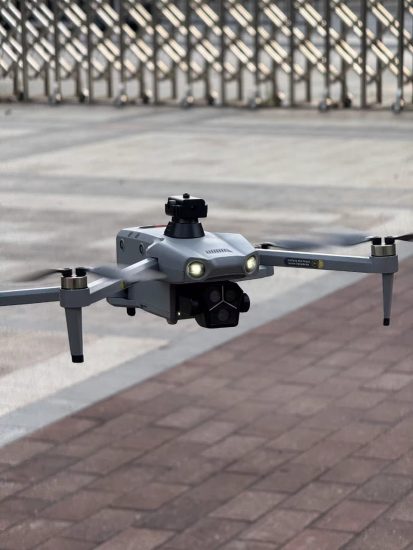
MSOEN’s drones are not off-the-shelf models adapted for industrial use; they are purpose-built systems integrating advanced sensors, robust hardware, and AI-driven analytics. At their core are five innovations that set them apart.
1. Multi-Sensor Fusion: Seeing the Unseen
The key to effective pipeline inspection lies in detecting both visible and invisible threats. MSOEN’s drones carry a suite of sensors that work in harmony:
-
High-Resolution Visual Cameras: 4K cameras with 20x optical zoom capture detailed images of above-ground pipes, welds, and fittings. MSOEN’s proprietary “stitching algorithm” combines thousands of images into a seamless 3D model of the pipeline, allowing operators to measure wear, rust, or physical damage (e.g., dents from construction equipment) with millimeter precision.
-
Infrared (IR) Thermal Imagers: Methane leaks cool the surrounding air, creating temperature anomalies detectable by IR cameras. MSOEN’s thermal sensors (with a resolution of 640×512 pixels) identify these “cold spots” from 50 meters away, even in total darkness. For buried pipes, the camera detects heat signatures from escaping gas that rises through soil.
-
Tunable Diode Laser (TDLAS) Gas Detectors: The most critical component, TDLAS sensors measure methane concentrations with parts-per-billion (ppb) sensitivity. Mounted in a downward-facing probe, the sensor samples air as the drone flies, creating a “gas plume map” that pinpoints leak locations. MSOEN’s TDLAS system is calibrated to ignore background methane (e.g., from wetlands) and focus on pipeline-related emissions.
-
Acoustic Microphones: Sensitive microphones record sound waves generated by gas escaping through cracks. By analyzing frequency patterns, the drone distinguishes between normal pipeline noise (e.g., flow turbulence) and abnormal leaks, even those too small to trigger thermal sensors.
This multi-sensor fusion ensures no threat goes unnoticed. In tests, MSOEN drones detected 98% of simulated leaks, compared to 65% for human patrols and 75% for ground vehicles.
2. Autonomous Navigation: Mastering Complex Terrains
Pipelines traverse some of the most challenging landscapes on Earth. MSOEN’s drones navigate these with:
-
RTK-GPS + LiDAR Positioning: Real-Time Kinematic (RTK) GPS provides centimeter-level accuracy, while LiDAR creates a 3D map of the environment. Together, they allow the drone to follow pipeline routes with <1 meter deviation, even in areas with poor GPS signals (e.g., dense forests or urban canyons).
-
Obstacle Avoidance Suite: Ultrasonic sensors (for close-range objects), vision cameras (for identifying trees, rocks, or power lines), and radar (for low-light conditions) enable the drone to autonomously adjust its path. If a flock of birds crosses its route, the drone slows down or climbs to avoid collision.
-
Long-Range Communication: A 5G-enabled transceiver maintains contact with the control station up to 20 kilometers away, transmitting live sensor data and receiving commands. For remote pipelines (e.g., in deserts), MSOEN uses satellite communication (Iridium) to ensure connectivity.
The result is a drone that can fly 100 kilometers of pipeline in 4 hours—10 times faster than a ground crew.
3. Ruggedized Design: Built for Harsh Environments
Pipeline rights-of-way expose drones to extreme conditions. MSOEN’s airframes are engineered for durability:
-
Carbon Fiber Composite Body: Lightweight yet strong, the frame resists impacts from branches or debris. A waterproof coating protects internal components from rain, snow, or mud.
-
Wide-Temperature Operation: From -30°C (Siberian winters) to 50°C (Middle Eastern summers), MSOEN drones maintain performance thanks to heated battery compartments and cooling fans.
-
Anti-Corrosion Materials: Aluminum alloy parts are treated with a ceramic coating to resist rust, critical for coastal pipelines exposed to saltwater.
In a 2023 field trial in Alaska, an MSOEN drone operated continuously for 6 hours in subzero temperatures, inspecting a 60-kilometer pipeline buried under permafrost.
4. AI-Powered Analytics: Turning Data into Action
Raw sensor data is useless without analysis. MSOEN’s cloud platform, PipeGuard AI, processes drone-collected information in real time:
-
Leak Detection Algorithm: Trained on millions of simulated and real-world leak scenarios, the AI distinguishes between true leaks and false positives (e.g., passing cars emitting exhaust). It assigns a “risk score” to each anomaly, prioritizing urgent cases (e.g., a 10 ppm methane spike) for immediate review.
-
Corrosion Prediction Model: By combining visual images, thermal data, and historical inspection records, the AI predicts which pipe sections are most likely to corrode in the next 6–12 months. Operators can then schedule targeted maintenance, avoiding costly emergency repairs.
-
Compliance Reporting: The platform automatically generates reports compliant with international standards (e.g., API 1163, PHMSA regulations), including maps of inspected areas, detected issues, and recommended actions.
For a major European gas operator, PipeGuard AI reduced report generation time from 2 days to 2 hours, freeing engineers to focus on repairs.
5. Modular Payloads: Adapting to Any Pipeline
No two pipelines are identical. MSOEN’s drones feature modular payload bays, allowing operators to swap sensors based on needs:
-
Above-Ground Inspection Kit: Includes visual cameras, IR imagers, and acoustic mics for exposed pipelines.
-
Buried Pipeline Kit: Adds ground-penetrating radar (GPR) to detect voids or soil erosion around buried pipes, and a magnetic flux leakage (MFL) sensor to identify internal corrosion.
-
Emergency Response Kit: For post-leak scenarios, this kit includes a high-power spotlight and a speaker to communicate with ground teams.
This flexibility makes MSOEN drones suitable for all pipeline types: transmission lines (high-pressure, long-distance), distribution networks (low-pressure, urban), and offshore platforms.
Applications: Securing Pipelines Across the Globe
MSOEN’s drones are deployed in diverse settings, solving unique challenges.
Remote Wilderness: Covering the Unreachable
In Canada’s boreal forests, a 500-kilometer pipeline runs through rugged terrain inaccessible to vehicles. An MSOEN P-800 drone (MSOEN’s heavy-duty model) flies weekly missions, covering the entire length in 8 hours. In 2022, it detected a small methane leak caused by a bear clawing at a valve—an incident that would have gone unnoticed for weeks by human patrols. The early detection prevented a potential explosion and saved the operator $2 million in cleanup costs.
Urban Areas: Navigating Crowded Spaces
Beneath Tokyo’s bustling streets lies a network of gas pipelines serving 13 million people. Inspecting these requires avoiding skyscrapers, power lines, and crowded airspace. MSOEN’s P-400 compact drone, with its quiet electric motors and obstacle avoidance system, flies at 50 meters altitude, using GPR to map buried pipes. In 2023, it identified a corroded joint under a busy intersection, allowing repairs to be made at night, minimizing disruption to traffic.
Offshore Platforms: Taming the Sea
Offshore pipelines are vulnerable to wave action, salt corrosion, and marine growth. MSOEN’s P-1000 marine-grade drone, with a corrosion-resistant titanium frame and saltwater-proof sensors, inspects platforms in the North Sea. In one mission, it detected a hairline crack in a subsea pipe, which was repaired before a storm could worsen the damage.
Aging Infrastructure: Extending Pipeline Lifespans
Many pipelines worldwide are over 50 years old, with a high risk of failure. A U.S. utility company used MSOEN drones to inspect 200 miles of aging cast-iron pipes. The AI identified 12 sections with severe internal corrosion, allowing the company to replace them proactively. This avoided 3 potential leaks and extended the pipeline’s lifespan by 15 years.
The MSOEN Advantage: Safety, Efficiency, and Sustainability
The impact of MSOEN’s drones is measured in three key areas.
1. Enhanced Safety
By replacing human patrols in hazardous areas, MSOEN drones have eliminated 90% of inspection-related injuries. For a Middle Eastern operator, this meant no more sending workers into 50°C desert heat, reducing heatstroke cases to zero.
2. Operational Efficiency
-
Faster Inspections: A 1,000-kilometer pipeline that takes 2 weeks to inspect by ground vehicle is covered in 1 day by an MSOEN drone.
-
Cost Reduction: MSOEN drones cost 40% less to operate than ground crews, with savings coming from reduced labor, fuel, and vehicle maintenance.
-
24/7 Monitoring: MSOEN offers a “drone-as-a-service” model, with drones patrolling pipelines round-the-clock, providing real-time alerts for leaks.
3. Environmental Protection
Methane is a potent greenhouse gas, 84 times more warming than CO₂ over 20 years. MSOEN drones detect leaks as small as 0.1 kg/hour, preventing the release of thousands of tons of methane annually. In a 2023 project in Australia, MSOEN drones reduced methane emissions from a pipeline by 60% by identifying and repairing 8 small leaks.
Challenges and the Path Forward
While MSOEN’s technology is transformative, challenges remain:
-
Battery Life: Current models offer 2–4 hours of flight time, requiring mid-mission battery swaps for long pipelines. MSOEN is developing hydrogen fuel cell systems to extend endurance to 8+ hours.
-
Regulatory Hurdles: Some countries restrict beyond-visual-line-of-sight (BVLOS) flights, limiting drone range. MSOEN is working with regulators to establish safety standards for autonomous pipeline inspection.
-
Data Overload: The volume of sensor data (terabytes per mission) can overwhelm operators. MSOEN is enhancing PipeGuard AI to provide more concise, actionable insights.
Looking ahead, MSOEN plans to integrate:
-
Swarm Technology: Coordinating 5–10 drones to inspect a pipeline simultaneously, cutting time by 80%.
-
Predictive Maintenance 2.0: Using machine learning to forecast pipeline failures based on weather, soil conditions, and usage patterns.
-
Integration with IoT: Linking drones to smart valves and sensors for automated leak response (e.g., closing a valve remotely when a leak is detected).
Conclusion
Natural gas pipelines are critical to global energy security, but their safety depends on rigorous inspection. Traditional methods, fraught with danger and inefficiency, are no longer sufficient. MSOEN’s pipeline inspection drones represent a paradigm shift—combining advanced sensors, autonomous navigation, and AI analytics to protect infrastructure, save lives, and reduce environmental harm.
As the world transitions to cleaner energy, the need for reliable pipeline networks will only grow. MSOEN’s drones are not just tools; they are guardians of the energy arteries that power our modern lives. By turning aerial intelligence into actionable safety measures, MSOEN is ensuring that natural gas flows safely, today and for generations to come.
THE END


No comments yet