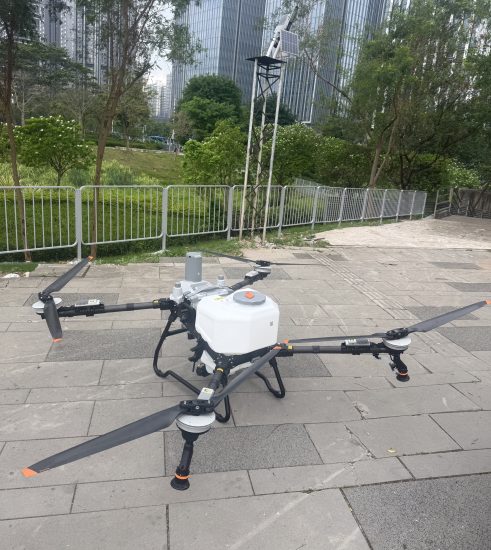



Choosing the correct spraying capacity and battery configuration is one of the most important decisions when purchasing an agricultural spraying drone.
A drone with a larger tank is not automatically better. A larger payload requires more lifting power and battery energy, while a battery with higher capacity can increase flight endurance but also adds weight.
For farms, agricultural contractors, distributors, and international buyers sourcing drones from China, the goal should be to find a balanced configuration that provides sufficient spraying capacity, practical flight time, efficient battery use, and manageable operating costs.
This guide explains how to select the appropriate tank capacity and battery configuration for different agricultural applications.
1. Understand the Relationship Between Tank Capacity and Payload
The spraying tank determines how much liquid the drone can carry during each flight.
A larger tank can reduce the number of refills, but the aircraft must carry more weight.
The total takeoff weight includes:
Drone Weight + Battery Weight + Liquid Payload + Accessories
As the payload increases, the motors need to generate more lift and the battery generally needs to provide more power.
Therefore, buyers should not select tank capacity independently from the drone’s propulsion and battery system.
2. Choose Tank Capacity Based on Your Farm
The right tank size depends on the scale and characteristics of your operation.
Small Farms
Smaller farms may benefit from a more compact drone.
Advantages can include:
-
Easier transportation
-
Lower initial investment
-
Lower battery requirements
-
Easier operation
-
Better maneuverability
A smaller tank can also be practical where fields are divided into many small sections.
Medium-Sized Farms
Medium-sized agricultural operations may require a balance between payload and maneuverability.
A medium-capacity drone can reduce refill frequency without creating excessive payload requirements.
Large Agricultural Operations
Large farms and professional spraying contractors may benefit from higher-capacity systems.
The objective is usually to increase operational efficiency by reducing:
-
Number of refills
-
Travel time to refill locations
-
Battery changes
-
Operator downtime
However, higher capacity also means that the supporting infrastructure must be capable of handling the heavier system.
3. Crop Type Matters
Different crops require different spraying strategies.
For example, open-field crops and orchards can have very different requirements.
Open-field applications may prioritize:
-
Large operating areas
-
Efficient route planning
-
High productivity
-
Stable flight at consistent altitude
Orchard operations may prioritize:
-
Maneuverability
-
Obstacle detection
-
Terrain following
-
Appropriate spray coverage
-
Precise flight control
Tell the manufacturer what crop you intend to spray before selecting the drone.
4. Spraying Volume Is More Important Than Tank Size Alone
Tank capacity tells you how much liquid the drone can carry, but it does not tell you how much liquid should be applied per hectare.
The required application volume depends on the crop, product, agricultural practice, and local recommendations.
For example, if a particular operation requires a lower application volume per hectare, a smaller tank may cover a relatively large area.
If the required application volume is higher, the same tank will cover less area before requiring a refill.
Therefore, buyers should determine their actual application requirements before selecting the tank.
5. Consider the Spraying Flow Rate
The pump determines how quickly liquid can be delivered through the nozzles.
Important specifications include:
-
Maximum flow rate
-
Adjustable flow range
-
Number of pumps
-
Pump durability
-
Flow-control accuracy
The pump should be matched to the nozzle configuration and required application rate.
A high-capacity tank is not useful if the spraying system cannot deliver the required flow efficiently.
6. Nozzle Configuration Also Matters
Nozzles affect spray distribution and application performance.
When evaluating a drone, ask about:
-
Number of nozzles
-
Nozzle type
-
Spray pattern
-
Replaceability
-
Filter configuration
-
Flow rate per nozzle
The correct nozzle depends on the spraying application and product being applied.
The manufacturer should be able to provide technical information rather than simply stating that the drone has a certain number of nozzles.
7. Battery Capacity Must Match the Drone
Battery selection is closely related to payload.
A battery provides the energy required to operate:
-
Motors
-
Flight controller
-
Navigation systems
-
Sensors
-
Pump system
-
Communication systems
A larger payload generally increases energy consumption.
However, adding an excessively large battery can also increase the drone’s weight.
This creates an important engineering balance:
More Battery Capacity → Potentially Longer Endurance
but also:
More Battery Weight → Higher Energy Requirement
Therefore, battery selection should follow the manufacturer’s tested configuration rather than simply choosing the battery with the largest capacity.
8. Battery Voltage and Capacity Are Different
International buyers sometimes focus only on battery capacity.
Battery voltage is also important.
Battery energy can be considered approximately as:
Energy (Wh) = Voltage (V) × Capacity (Ah)
For example, a battery with a higher voltage and a given capacity can store a different amount of energy than a lower-voltage battery with the same amp-hour rating.
When comparing batteries, look at the complete specification rather than only the Ah value.
9. Consider Battery Weight
Battery weight is particularly important for agricultural drones.
A larger battery may provide more energy, but it also adds weight.
The manufacturer should provide a tested battery configuration for the specific drone.
Ask:
-
Battery weight
-
Battery capacity
-
Voltage
-
Recommended battery
-
Maximum battery quantity
-
Typical flight time
-
Charging time
Avoid replacing the manufacturer’s recommended battery with a significantly heavier battery without confirming compatibility.
10. Calculate Practical Flight Time
Maximum flight time is not the same as practical spraying time.
Actual operating time can be affected by:
-
Payload
-
Wind
-
Temperature
-
Flight speed
-
Battery age
-
Terrain
-
Spraying flow
-
Flight altitude
A manufacturer may provide a maximum flight-time figure measured under specific conditions.
Ask for practical flight data with the drone carrying a normal spraying load.
This will provide a more useful basis for purchasing decisions.
11. Full Tank vs. Empty Tank Flight Time
The difference between an empty tank and a full tank can be significant.
At the beginning of a spraying operation, the drone carries the maximum liquid payload.
As the liquid is consumed, the aircraft becomes lighter.
Therefore, buyers should ask manufacturers for operating data under realistic payload conditions.
A useful question is:
What is the expected flight time with the recommended battery and a full spraying tank?
This is more meaningful than asking only for the maximum unloaded flight time.
12. Battery Quantity Is Important for Commercial Operations
A commercial operator may need several batteries rather than only one.
A typical operating cycle may involve:
-
Battery installed
-
Drone takes off
-
Spraying operation
-
Drone lands
-
Battery replaced
-
Used battery begins charging
-
Fully charged battery installed
-
Operation continues
The number of batteries required depends on:
-
Flight time
-
Charging time
-
Working hours
-
Number of drones
-
Field size
-
Charging infrastructure
If charging takes longer than the operating cycle, additional batteries may be necessary.
13. Fast Charging Can Improve Productivity
A faster charging system can reduce battery-related downtime.
However, buyers should not evaluate a charger only by its advertised charging speed.
Also check:
-
Battery temperature management
-
Charging safety
-
Charger power requirements
-
Battery compatibility
-
Charging-cycle recommendations
The charger and battery should be designed as a compatible system.
14. Consider Your Local Power Supply
International buyers should tell the manufacturer the destination country.
Confirm:
-
Input voltage
-
Frequency
-
Plug type
-
Charger requirements
-
Power capacity
This is especially important when importing equipment for commercial operations.
A high-power charger may require an electrical supply that is not available at every farm.
15. Weather Conditions Affect Battery Performance
Battery performance can vary with temperature.
Very low or very high temperatures can affect battery behavior, charging requirements, and available energy.
Ask the manufacturer about the recommended operating and charging temperature range.
If the drone will be used in a particularly hot, cold, humid, or windy region, this should be discussed before selecting the battery configuration.
16. Terrain Influences Capacity Selection
Flat farmland and mountainous terrain create different operating conditions.
In mountainous areas, the drone may need to:
-
Change altitude frequently
-
Navigate uneven terrain
-
Operate around obstacles
-
Maintain stable spraying height
These conditions can affect energy consumption and operational efficiency.
A manufacturer should know your terrain before recommending the battery and tank configuration.
17. Orchards Require Special Consideration
Orchards can be more complicated than open fields.
The drone may need to maneuver around:
-
Trees
-
Branches
-
Slopes
-
Buildings
-
Power lines
-
Other obstacles
In such environments, maximum tank capacity may be less important than maneuverability and flight-control capabilities.
A smaller or medium-capacity system may sometimes be more practical if it allows better control in confined areas.
18. Calculate Operating Efficiency
One useful way to compare configurations is to evaluate the complete operating cycle.
Consider:
Spraying Time + Refilling Time + Battery Replacement Time + Charging Time + Travel Time
A drone with a larger tank may reduce refilling frequency.
A drone with a larger battery may increase flight endurance.
But if the battery takes significantly longer to charge, the overall productivity may not improve.
The best configuration is therefore the one that minimizes total downtime.
19. Don’t Choose the Largest Battery Automatically
A common mistake is assuming that the biggest battery provides the best performance.
This is not always true.
An oversized battery can increase:
-
Aircraft weight
-
Motor load
-
Energy consumption
-
Purchase cost
-
Charging requirements
The battery should be selected according to the drone manufacturer’s tested propulsion system and payload configuration.
20. Ask the Manufacturer for a Recommended Configuration
When contacting a Chinese manufacturer, provide detailed information.
For example:
Application: Agricultural spraying
Crop: [Crop type]
Field size: [Hectares]
Terrain: Flat / Mountain / Orchard
Target application volume: [Your requirement]
Expected working hours: [Hours per day]
Destination: [Country]
Then ask the manufacturer to recommend:
-
Drone model
-
Tank capacity
-
Battery type
-
Battery quantity
-
Charger
-
Nozzle configuration
-
Spare-parts package
A professional manufacturer should be able to explain why the recommended configuration is suitable.
21. Questions to Ask Before Ordering
Before placing an order, ask:
About the Tank
-
What is the tank capacity?
-
What is the maximum payload?
-
What is the recommended operating payload?
-
What material is the tank made from?
About the Battery
-
What is the voltage?
-
What is the capacity?
-
What is the battery weight?
-
What is the expected cycle life?
-
What is the charging time?
-
What is the warranty?
About the Charger
-
What is the input voltage?
-
How many batteries can be charged?
-
What is the charging time?
-
What safety protections are included?
About Operation
-
What is the practical flight time with a full tank?
-
What is the typical operating speed?
-
What is the spraying flow rate?
-
What is the expected operational efficiency?
22. How to Compare Two Drone Configurations
Consider two hypothetical configurations:
Feature |
Configuration A |
Configuration B |
|---|---|---|
Tank |
Smaller |
Larger |
Battery |
Lower capacity |
Higher capacity |
Maneuverability |
Higher |
Lower |
Refill frequency |
Higher |
Lower |
Battery weight |
Lower |
Higher |
Initial cost |
Lower |
Higher |
Suitable application |
Small/complex fields |
Larger fields |
Neither configuration is automatically better.
The correct choice depends on the agricultural environment.
23. Battery Replacement Cost Should Be Included
Batteries are consumable components and should be included in long-term budgeting.
Ask the manufacturer:
-
Current replacement battery price
-
Expected cycle life
-
Warranty
-
Availability
-
Replacement lead time
If you operate internationally, also consider transportation requirements for replacement lithium batteries.
24. Maintain Batteries Correctly
Battery service life can be affected by how the batteries are used and stored.
Follow the manufacturer’s instructions for:
-
Charging
-
Storage
-
Temperature
-
Inspection
-
Transportation
-
Cleaning
-
Long-term storage
Do not use damaged batteries.
Operators should also follow the manufacturer’s safety procedures for charging and handling.
Frequently Asked Questions
What tank capacity should I choose for an agricultural spraying drone?
It depends on your crop, field size, application volume, terrain, refill facilities, and required productivity. Larger tanks reduce refill frequency but increase payload requirements.
Is a larger battery always better?
No. A larger battery stores more energy but also adds weight. The correct battery should be compatible with the drone’s propulsion system and tested payload configuration.
Should I buy extra batteries?
For commercial operations, additional batteries are often useful because they can reduce downtime between flights. The exact number depends on flight time, charging time, working hours, and the number of drones.
How can I estimate practical flight time?
Ask the manufacturer for flight-time data under realistic conditions, preferably with the recommended battery and normal spraying payload. Maximum unloaded flight time is less useful for commercial planning.
Does crop type affect drone selection?
Yes. Open-field crops, orchards, vineyards, and mountainous farmland can have very different operating requirements. The manufacturer should know the crop and terrain before recommending the configuration.
What information should I provide when asking for a quotation?
Provide your crop type, field size, terrain, expected application volume, destination country, desired tank capacity if known, battery requirements, order quantity, and OEM requirements if applicable.
Final Checklist
Before purchasing an agricultural spraying drone, confirm:
-
[ ] Tank capacity
-
[ ] Maximum payload
-
[ ] Recommended operating payload
-
[ ] Pump flow rate
-
[ ] Nozzle configuration
-
[ ] Battery voltage
-
[ ] Battery capacity
-
[ ] Battery weight
-
[ ] Battery cycle life
-
[ ] Charging time
-
[ ] Charger specification
-
[ ] Practical flight time
-
[ ] Expected operating efficiency
-
[ ] Spare battery price
-
[ ] Spare-parts availability
-
[ ] Warranty
-
[ ] Destination-country requirements
Conclusion
Choosing the correct spraying capacity and battery is about finding the right balance between payload, flight endurance, spraying performance, operating efficiency, and total cost.
A larger tank can reduce refill frequency, while a larger battery can increase potential endurance. However, both also increase weight and may affect energy consumption.
For international buyers sourcing agricultural spraying drones from China, the safest approach is to provide the manufacturer with detailed information about the crop, field size, terrain, application requirements, and working conditions.
A reliable manufacturer should then recommend a tested combination of drone, tank, battery, charger, pump, and nozzle system rather than simply selling the largest configuration available.
The best agricultural drone is not necessarily the one with the biggest tank or battery. It is the one whose complete configuration matches your actual farming operation and delivers reliable performance at a sustainable operating cost.
THE END


No comments yet