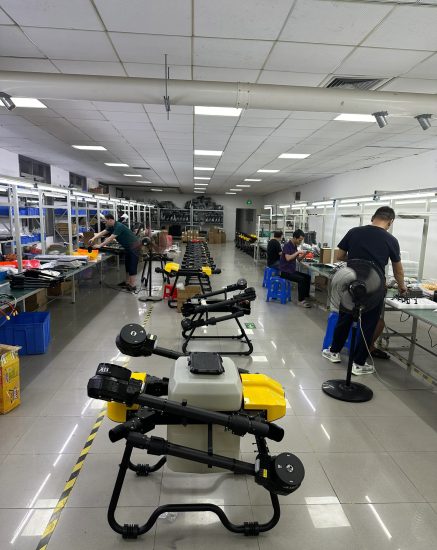


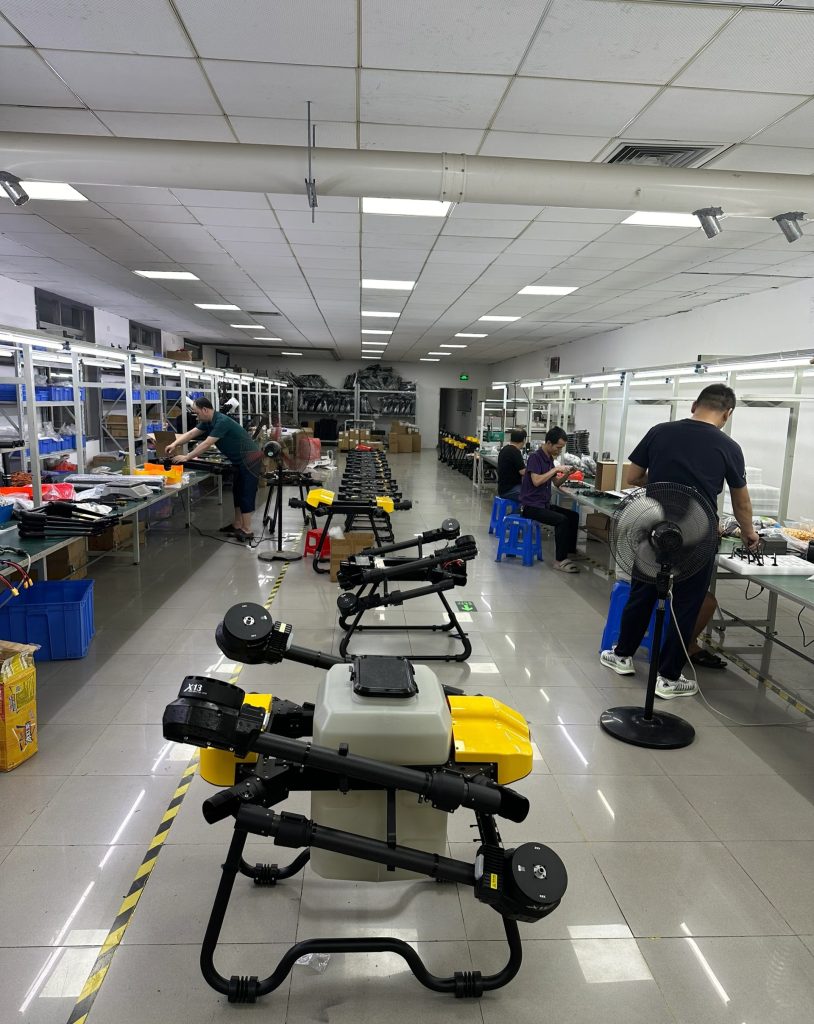
Fruit orchards are more challenging to spray than many open-field crops. Trees can have different heights, dense canopies, narrow planting rows, uneven terrain, and changing leaf density throughout the growing season. Traditional spraying methods may require workers or ground machinery to move between rows, which can make certain orchard operations slow, labor-intensive, or difficult to organize.
A fruit orchard spraying drone provides an aerial method for applying approved agricultural products over and around fruit trees. The aircraft carries a liquid tank and precision spraying system while following a planned route above or alongside the orchard canopy.
A professional orchard spraying drone should be designed around the actual characteristics of fruit trees rather than simply adapting an open-field crop drone. The aircraft, spray system, flight control, navigation, obstacle detection, battery system, and operating parameters all need to work together.
What Is a Fruit Orchard Spraying Drone?
A fruit orchard spraying drone is an agricultural unmanned aerial vehicle equipped with a liquid spraying system designed for fruit-tree crop protection and other permitted agricultural applications.
A typical system includes:
-
Agricultural UAV platform
-
High-performance motors
-
Propellers
-
Liquid tank
-
Electric pumps
-
Filters
-
Spray pipes
-
Agricultural nozzles
-
Flow-control system
-
GPS or RTK positioning
-
Flight controller
-
Remote controller
-
Intelligent batteries
-
Battery charger
-
Obstacle-detection sensors
-
Safety and monitoring functions
The drone can follow a manually controlled or programmed flight route around the orchard. The spraying system releases liquid through calibrated nozzles according to the selected operating parameters.
The purpose is not simply to spray a large amount of liquid. The objective is to achieve useful and consistent deposition on the intended parts of the tree while controlling drift and avoiding unnecessary application.
Why Are Orchards Different From Open Fields?
A wheat, corn, or rice field generally presents a relatively continuous crop surface. Fruit orchards are structurally different.
Trees create three-dimensional targets.
A mature tree may have:
-
Outer leaves
-
Inner leaves
-
Branches
-
Fruit clusters
-
Upper canopy
-
Middle canopy
-
Lower canopy
-
Open spaces between trees
This makes orchard spraying more complicated.
The aircraft needs to account for tree height, canopy width, row spacing, terrain, and surrounding obstacles.
For this reason, a fruit-tree spraying drone should not be evaluated using only the same criteria used for a standard field-crop spraying drone.
Main Applications of Orchard Spraying Drones
The actual application depends on the crop, agricultural product, growth stage, weather, and regulations of the operating country.
Insect Control
Fruit trees can be affected by different insect pests during different growth stages.
A drone can provide an aerial application method for approved insect-control products where aerial application is permitted.
The objective is to place sufficient product on the target canopy while minimizing unnecessary off-target movement.
Disease Management
Fungal and bacterial diseases can affect leaves, branches, flowers, and fruit.
Orchard disease management often depends on timely application.
A drone can help operators cover larger orchard areas without requiring ground machinery to travel between every tree row.
Fungicide Application
Fungicide applications require appropriate coverage because disease targets may exist throughout the canopy.
The correct spray configuration depends on:
-
Tree size
-
Canopy density
-
Product
-
Required application rate
-
Nozzle type
-
Flight speed
-
Flight height
-
Weather
Foliar Nutrient Application
Certain liquid fertilizers and foliar nutrients may also be suitable for drone application when the product and application method are approved.
The required concentration and application volume should be determined according to the product and crop requirements.
The Main Challenge: Dense Tree Canopies
Dense canopies are one of the biggest challenges in orchard spraying.
If droplets are released from above a dense tree, some may remain on the upper leaves while less reaches the inner canopy.
This means that simply increasing spray volume does not automatically guarantee better coverage.
The operator needs to consider how rotor airflow, flight direction, altitude, nozzle arrangement, droplet characteristics, and tree structure interact.
Professional orchard spraying therefore requires calibration and field testing.
Rotor Airflow and Spray Deposition
Agricultural drones use powerful rotors to generate lift.
The resulting downward airflow can influence the movement of spray droplets.
In an orchard, this airflow interacts with:
-
Leaves
-
Branches
-
Fruit
-
Ground
-
Tree trunks
-
Air movement between rows
The result can vary significantly depending on tree structure and operating conditions.
This is why orchard spraying should be treated as a specialized application rather than simply increasing the flow rate of a field-crop spraying system.
Branch and Canopy Coverage
The outer canopy is generally easier to reach than the interior of a dense tree.
For certain applications, the drone may need to operate with specific flight paths or spray directions to improve distribution around the target canopy.
A professional system can be configured with adjustable spraying parameters so that operators can adapt the operation to different tree sizes and orchard layouts.
The goal should be to create an appropriate spray pattern rather than assuming that one fixed setting works for every orchard.
Spray Tank Capacity
Tank capacity is an important specification, but it should not be the only purchasing criterion.
A larger tank can reduce the number of refilling operations. However, it also increases takeoff weight and energy consumption.
The appropriate tank capacity depends on:
-
Orchard size
-
Tree density
-
Application volume
-
Battery capacity
-
Water availability
-
Refill distance
-
Daily working target
-
Transportation requirements
For a small orchard, a compact system may be more convenient.
For a large commercial orchard, a higher-capacity aircraft may reduce downtime.
The best configuration depends on the complete operating cycle.
Pump System
A reliable pump is essential for maintaining consistent liquid delivery.
The pump should provide stable flow across the required operating range.
A high maximum flow rate is not automatically an advantage.
The system needs to provide the correct amount of liquid for the selected application rather than simply delivering the maximum possible volume.
Nozzles and Spray Pattern
Nozzles are among the most important components of an orchard spraying system.
They influence:
-
Droplet characteristics
-
Spray direction
-
Spray pattern
-
Coverage
-
Drift potential
-
Application consistency
Different fruit trees may require different spraying configurations.
For example, a young orchard with relatively small trees may require a different setup from a mature orchard with a dense canopy.
Nozzle selection should therefore consider tree structure, product requirements, application volume, weather, and the manufacturer’s recommendations.
Flow Control
Electronic flow control can help maintain a consistent application rate.
When the aircraft changes speed, the required liquid flow can change.
A simplified relationship is:
Application Rate ≈ Flow Rate ÷ (Flight Speed × Effective Spray Width)
This relationship shows why flight speed and liquid flow should be considered together.
Actual orchard spraying is more complicated because tree density, route overlap, nozzle arrangement, rotor airflow, terrain, and wind can also affect deposition.
Therefore, field calibration is essential.
Flight Height
Flight height has a direct influence on spray behavior.
Flying too high can increase the distance droplets travel and may increase drift under unsuitable conditions.
Flying too low can create other problems, including strong airflow interaction with the tree canopy and reduced operating clearance.
The correct height depends on:
-
Tree height
-
Canopy shape
-
Drone design
-
Nozzle configuration
-
Flight speed
-
Weather
-
Terrain
-
Agricultural product
There is no universal flight height suitable for every orchard.
Orchard Row Spacing
Fruit orchards can have very different planting layouts.
Some orchards have wide rows suitable for larger aircraft, while others have narrow spacing and limited maneuvering room.
Before purchasing a drone, buyers should provide information about:
-
Tree height
-
Tree width
-
Row spacing
-
Orchard area
-
Terrain
-
Typical obstacles
-
Required application
This information can help the manufacturer recommend a suitable aircraft and operating configuration.
Terrain and Sloped Orchards
Many fruit orchards are located on uneven or sloped terrain.
Hills can create additional challenges for agricultural drone operation.
A professional navigation system may support terrain-related flight functions, but the operator should still inspect the site and understand local hazards.
Trees, power lines, poles, buildings, fences, and irrigation infrastructure can all create risks.
The drone’s automated functions should be considered safety assistance rather than a replacement for responsible supervision.
Obstacle Detection
Orchards naturally contain many obstacles.
Common examples include:
-
Tree branches
-
Trunks
-
Utility poles
-
Power lines
-
Irrigation systems
-
Buildings
-
Fences
-
Farm equipment
Obstacle-detection technology can help identify some hazards.
However, no sensor system should be assumed to detect every obstacle under every condition.
Operators should inspect the orchard before flight and maintain appropriate control throughout the operation.
RTK and Navigation
Accurate positioning is valuable for orchard spraying because routes often need to be repeated along narrow tree rows.
RTK positioning can help improve route repeatability and reduce unnecessary deviations.
A typical orchard flight workflow may include:
-
Mapping the orchard
-
Identifying boundaries
-
Identifying obstacles
-
Setting the flight route
-
Establishing operating parameters
-
Performing a test flight
-
Calibrating the spray system
-
Beginning the main operation
-
Monitoring the flight
-
Inspecting the result
Good navigation supports the spraying process, but it cannot compensate for incorrect application settings.
Fruit Tree Varieties
Orchard spraying drones can potentially be used in many types of fruit orchards.
Examples include:
-
Apple orchards
-
Orange orchards
-
Lemon orchards
-
Mango orchards
-
Pear orchards
-
Peach orchards
-
Cherry orchards
-
Plum orchards
-
Avocado orchards
-
Citrus plantations
Different trees have different canopy structures.
A mango tree, for example, may have a very different canopy from a young citrus tree.
Therefore, a professional manufacturer should focus on adjustable configurations rather than claiming that one fixed spraying setup is ideal for every fruit crop.
Spraying During Different Growth Stages
Tree structure changes throughout the growing season.
Young trees may have a relatively small canopy, while mature trees can have dense foliage.
Flowering and fruit-development periods can also create special application considerations.
The operator should select the agricultural product and application parameters according to the crop stage and legal requirements.
The same drone may be able to support multiple operating configurations, but the parameters should be changed when the target crop structure changes.
Managing Spray Drift
Spray drift is a major consideration for orchard operations because orchards can be located near:
-
Other fruit varieties
-
Neighboring farms
-
Roads
-
Houses
-
Water sources
-
Sensitive vegetation
Wind conditions should be checked before spraying.
Droplet characteristics should be selected according to the agricultural product and application requirements.
Operators should also maintain appropriate buffer areas and comply with local pesticide and aviation regulations.
The goal is to place the product on the intended target rather than maximize the amount released into the air.
Battery and Daily Productivity
Battery management is critical for commercial orchard spraying.
The drone’s actual working cycle may include:
Takeoff → Orchard spraying → Landing → Battery replacement → Liquid refill → Inspection → Next flight
Traveling between distant orchard blocks can also consume time.
For this reason, buyers should consider the location of charging and refill stations when planning operations.
A well-organized battery and refill system can improve daily productivity without requiring the aircraft itself to become excessively large.
Maintenance of an Orchard Spraying Drone
Fruit orchards contain dust, leaves, pollen, moisture, and agricultural chemicals.
Regular maintenance is therefore essential.
Tank
Inspect and clean the tank after spraying.
Pump
Check flow performance and inspect for leaks or abnormal noise.
Nozzles
Inspect nozzles for blockage, wear, and changes in spray pattern.
Filters
Clean filters regularly and replace them when required.
Pipes
Inspect hoses and connectors for chemical damage or leakage.
Motors
Check motors for contamination and abnormal operation.
Propellers
Inspect propellers for cracks, deformation, or damage.
Batteries
Follow the manufacturer’s charging, storage, transportation, and inspection procedures.
Sensors
Keep radar, cameras, and other sensing components clean and inspect them before operation.
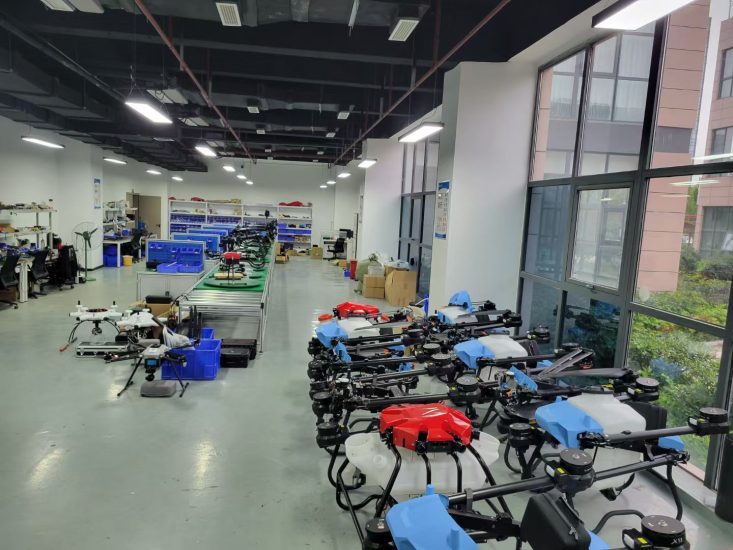
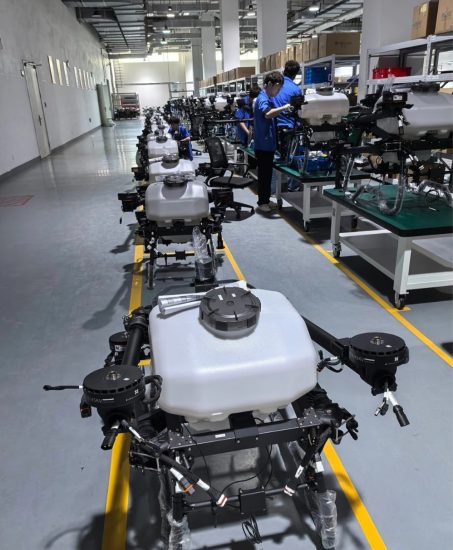
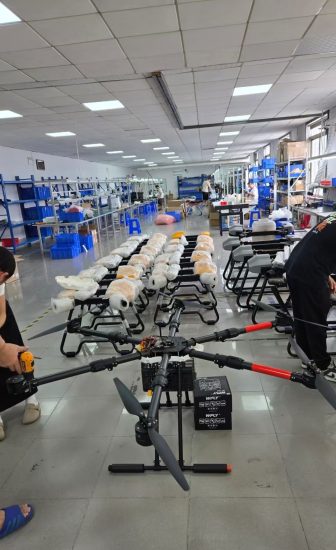
OEM Fruit Orchard Spraying Drone Manufacturing
International distributors may require customized orchard spraying drones for their local markets.
OEM and ODM options can include:
-
Custom logo
-
Product color
-
Packaging
-
Controller language
-
User manuals
-
Tank capacity
-
Battery configuration
-
Nozzle configuration
-
Spray system
-
Spare-parts packages
-
Software localization
The final configuration should be determined according to the customer’s orchard conditions and target market.
Before importing equipment, buyers should also check applicable regulations regarding agricultural UAVs, radio systems, batteries, pesticide application, and commercial drone operation.
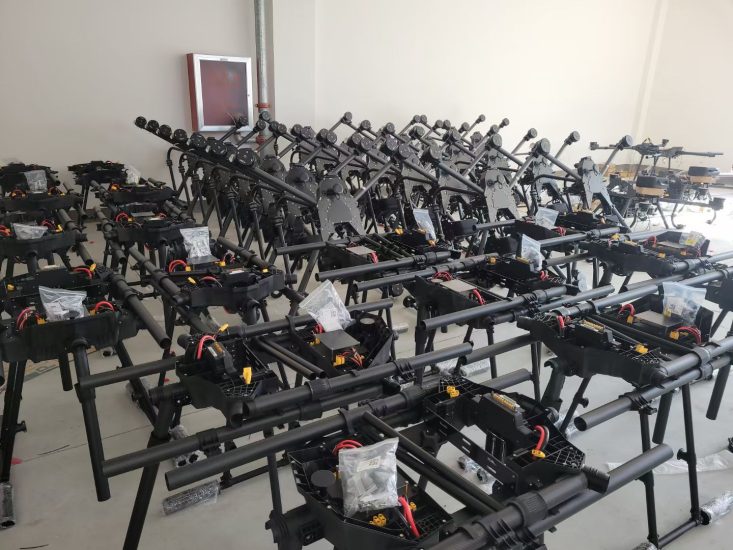
Quality Control
A professional orchard spraying drone manufacturer should conduct several inspections before shipment.
Structural Inspection
Check:
-
Frame
-
Arms
-
Landing gear
-
Motor mounts
-
Fasteners
Spray System Testing
Check:
-
Tank sealing
-
Pump operation
-
Flow rate
-
Filters
-
Pipes
-
Nozzles
-
Flow-control system
Navigation Testing
Check positioning, route planning, controller communication, and relevant safety functions.
Flight Testing
The aircraft should be tested for:
-
Takeoff
-
Hovering
-
Movement
-
Turning
-
Route operation
-
Landing
-
Return functions
Final Inspection
Confirm the aircraft, controller, batteries, charger, spare parts, tools, and documentation before export packaging.
What Should Buyers Ask a Fruit Orchard Spraying Drone Manufacturer?
Before purchasing, buyers should ask for detailed information about:
-
Tank capacity
-
Maximum payload
-
Recommended payload
-
Pump flow range
-
Nozzle options
-
Spray width
-
Flight endurance under load
-
Battery specifications
-
Charging system
-
Navigation system
-
RTK support
-
Obstacle detection
-
Terrain-following capability
-
Recommended orchard dimensions
-
Maintenance requirements
-
Spare parts
-
Warranty
-
Operator training
-
OEM services
-
Technical support
The manufacturer should be able to explain how the equipment is expected to perform under the customer’s actual orchard conditions.
Why Technical Support Matters
Orchard spraying can require more adjustment than open-field spraying.
Customers may need support with:
-
Route planning
-
Nozzle selection
-
Spray calibration
-
Flow settings
-
Flight parameters
-
Battery management
-
Sensor maintenance
-
Pump replacement
-
Spare parts
-
Troubleshooting
For commercial agricultural contractors, fast access to technical support can be important because spraying windows may be limited.
Final Thoughts
Fruit orchard spraying is a specialized agricultural application because trees are three-dimensional targets with changing canopy density, height, and structure.
A professional orchard spraying drone can provide a flexible aerial method for crop protection and other approved liquid applications.
However, the drone itself is only one part of the solution.
Reliable orchard operation depends on:
-
Stable flight performance
-
Appropriate payload capacity
-
Consistent liquid delivery
-
Suitable nozzle selection
-
Accurate navigation
-
Obstacle awareness
-
Proper flight parameters
-
Battery management
-
Regular maintenance
-
Operator training
The best orchard spraying drone is not necessarily the one with the largest tank or highest advertised speed. The right system is the one that matches the fruit variety, tree height, canopy density, row spacing, terrain, application requirements, and local operating conditions.
FAQ
1. What is a fruit orchard spraying drone?
A fruit orchard spraying drone is an agricultural UAV equipped with a liquid tank, pump, nozzles, navigation, and flight-control systems for permitted spraying applications in fruit orchards.
2. What fruit trees can be sprayed by drone?
Depending on the equipment and application requirements, agricultural drones can be used in orchards growing apples, oranges, lemons, mangoes, pears, peaches, cherries, plums, avocados, and other fruit crops.
3. Can a drone spray dense fruit-tree canopies?
Yes, but dense canopies require careful selection of flight parameters, spray configuration, nozzle type, droplet characteristics, and application volume. A larger liquid volume alone does not guarantee better canopy coverage.
4. Can orchard drones operate on hills?
Some agricultural drone systems can operate over uneven or sloped terrain, but the actual capability depends on aircraft design, navigation system, obstacle detection, operator skill, and local conditions.
5. Is RTK necessary for orchard spraying?
RTK is not mandatory for every operation, but accurate positioning can be valuable for repeatable flight routes, especially in orchards with narrow rows or complex layouts.
6. What tank capacity should I choose?
Tank capacity should be selected according to orchard size, application volume, tree density, refill distance, battery capacity, and daily working requirements. A larger tank also increases payload and energy consumption.
7. How much orchard area can a spraying drone cover per hour?
Actual productivity varies according to tree density, spray width, flight speed, application volume, tank capacity, battery changes, refilling time, terrain, and route layout. Manufacturers should provide working figures together with the conditions used to obtain them.
8. Can the same drone spray different fruit trees?
Yes, many agricultural drone platforms can support multiple fruit crops. However, the spraying parameters should be adjusted according to tree height, canopy structure, product requirements, and field conditions.
9. How can spray drift be reduced?
Operators should select appropriate application parameters, avoid unsuitable wind conditions, use suitable nozzles and droplet characteristics, maintain appropriate flight height, and follow the agricultural product label and local regulations.
10. How often should an orchard spraying drone be maintained?
The spray system should be inspected and cleaned after operations, while motors, propellers, batteries, sensors, wiring, and structural components should be checked regularly. Maintenance frequency should follow the manufacturer’s instructions and actual operating conditions.
11. Can you provide OEM fruit orchard spraying drones?
OEM customization may include branding, colors, packaging, controller language, manuals, tank configuration, battery configuration, spray components, and spare-parts packages, depending on the project.
12. What information is needed for a quotation?
For a suitable quotation, provide the destination country, expected order quantity, fruit variety, average tree height, tree spacing, orchard area, terrain conditions, preferred tank capacity, battery requirements, OEM requirements, and delivery destination. This allows the manufacturer to recommend a configuration suited to the actual orchard rather than providing a generic model.
THE END


No comments yet