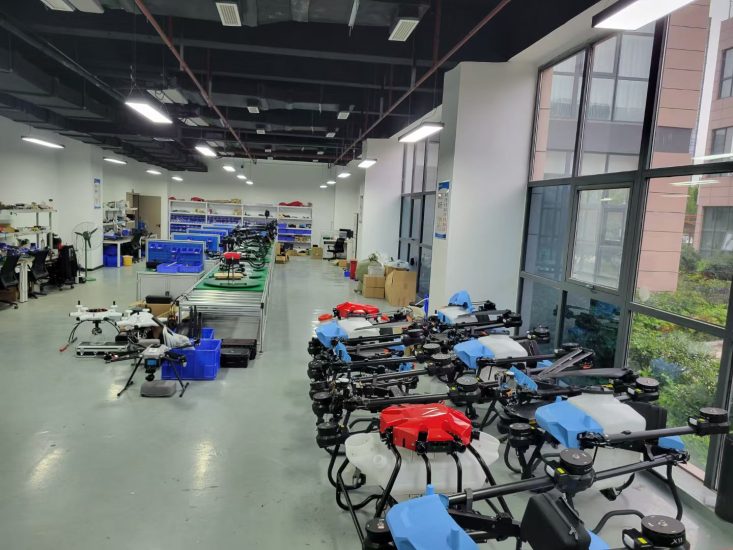


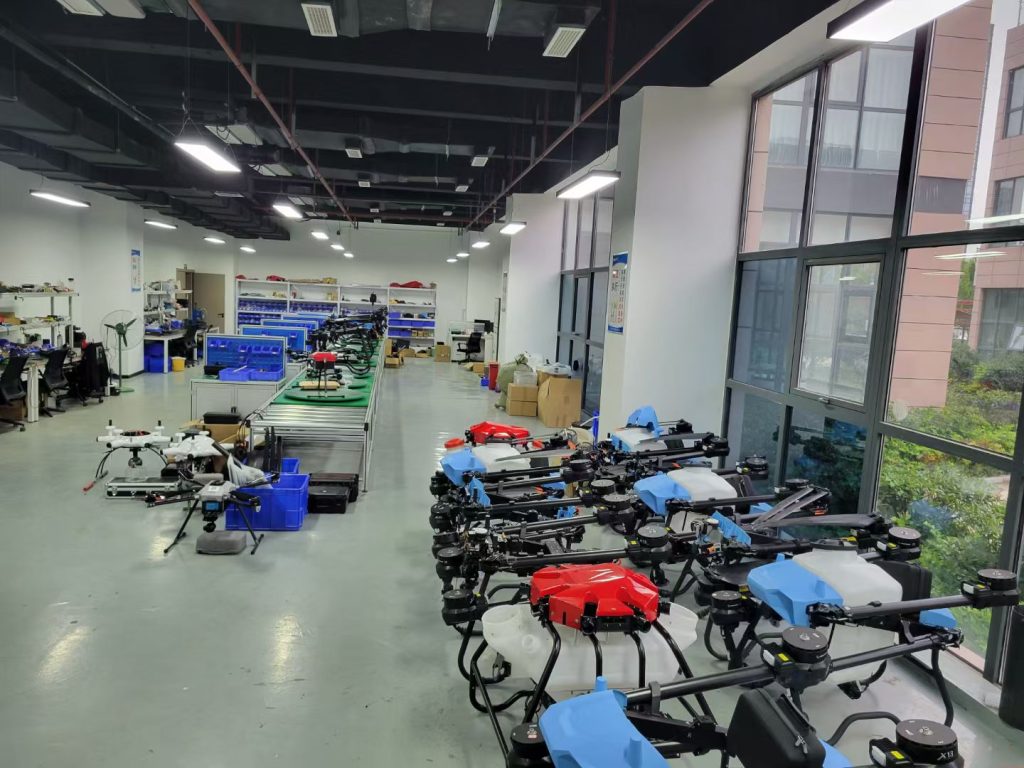
When farmers first consider using an agricultural drone for fertilizer application, one of the first questions is usually straightforward:
How much fertilizer can a drone carry?
The answer is more complicated than simply looking at the hopper capacity.
Agricultural fertilizer drones are available in different payload classes, and the right capacity depends on the fertilizer application rate, crop type, field size, battery performance, spreading system, and the amount of fertilizer that needs to be applied during each flight.
A 30 kg drone may be a practical choice for one farm, while a 50 kg model may make more sense for another. In some operations, a larger payload can reduce refill time significantly. In other situations, a smaller and lighter aircraft may be easier and cheaper to operate.
This guide explains how fertilizer drone payload works and how to calculate the capacity you actually need.
What Does “Fertilizer Drone Capacity” Mean?
When a manufacturer says an agricultural drone has a 30 kg payload, it generally means the aircraft is designed to carry up to approximately 30 kg of material under the specified operating conditions.
The payload is not the same as the total weight of the drone.
For example:
Empty aircraft weight + battery + fertilizer = total takeoff weight
If a drone has a 30 kg fertilizer payload, the 30 kg refers to the material carried by the spreading system, not the complete weight of the aircraft.
Buyers should therefore ask manufacturers for both:
-
Maximum payload
-
Maximum takeoff weight
These figures provide a better understanding of the aircraft’s actual design.
Common Fertilizer Drone Payload Classes
The market includes different sizes of agricultural spreading drones.
Typical configurations may include:
Payload Class |
Typical Use |
|---|---|
10–20 kg |
Small farms, testing, light agricultural work |
20–30 kg |
Small and medium-sized farms |
30–40 kg |
General commercial agricultural applications |
40–50 kg |
Larger farms and higher-volume fertilizer application |
50 kg+ |
High-capacity commercial operations |
These are broad categories rather than universal industry standards. Actual models vary between manufacturers.
The most important point is that payload should be matched to the application rate and operating environment.
How Much Area Can One Load Cover?
This is where payload capacity becomes useful.
The basic calculation is:
Area covered per load = fertilizer payload ÷ application rate
For example, if a drone carries 30 kg of fertilizer and the application rate is 30 kg per hectare:
30 kg ÷ 30 kg/ha = 1 hectare
So, under ideal conditions, one full load provides enough fertilizer for approximately one hectare.
If the application rate is 20 kg/ha:
30 kg ÷ 20 kg/ha = 1.5 hectares
If the application rate is 40 kg/ha:
30 kg ÷ 40 kg/ha = 0.75 hectares
This simple calculation is extremely useful when deciding between different drone sizes.
Example: 30 kg vs. 50 kg Drone
Suppose a farm applies 25 kg of fertilizer per hectare.
A 30 kg drone carries:
30 ÷ 25 = 1.2 hectares per load
A 50 kg drone carries:
50 ÷ 25 = 2 hectares per load
In theory, the 50 kg drone can treat a larger area before requiring a refill.
But that does not mean it will always be twice as efficient.
Actual productivity also depends on:
-
Flight speed
-
Spreading width
-
Battery endurance
-
Battery replacement time
-
Fertilizer loading speed
-
Distance between fields
-
Field shape
-
Wind
-
Operator experience
A larger hopper only solves one part of the productivity equation.
Why Payload Capacity Is Not the Same as Daily Productivity
A common mistake is to compare drones based only on kilograms.
Imagine a 50 kg drone that requires a long battery charging period after every few flights.
A 30 kg drone with a faster charging system and enough spare batteries may spend more time in the air during the same working day.
The actual workflow could look like this:
Drone A
30 kg load → flight → refill → battery replacement → flight
Drone B
50 kg load → flight → longer battery management cycle → refill → charging delay
The second drone has a larger payload, but the first may still achieve competitive daily productivity.
This is why professional buyers should request real operating data, not just payload specifications.
The Relationship Between Payload and Battery Life
Carrying more fertilizer increases the drone’s total weight.
A fully loaded aircraft generally requires more power than an aircraft carrying a partially filled hopper.
Therefore, flight time can change significantly depending on payload.
For example, a manufacturer may publish a maximum flight time measured under relatively light conditions.
That number should not automatically be interpreted as the flight time available while carrying the maximum fertilizer load.
When comparing drones, ask:
What is the expected flight time with the rated fertilizer payload?
This is a much more useful question.
What Happens When the Hopper Is Only Half Full?
A drone does not always need to carry its maximum payload.
Suppose a 50 kg drone is operating in a field where only 20 kg is required for the next application section.
There is no reason to fill the hopper to 50 kg if the additional material is unnecessary.
Operating with a partial load may reduce aircraft weight and power consumption.
However, the operator must still ensure that the spreading system can maintain the required application rate.
The objective is not to maximize the weight carried during every flight.
The objective is to deliver the correct amount of fertilizer to the correct area as efficiently as possible.
How Application Rate Changes Payload Requirements
Different crops and farming programs can require very different fertilizer rates.
For example, a field might require:
-
15 kg/ha
-
20 kg/ha
-
25 kg/ha
-
30 kg/ha
-
40 kg/ha
These numbers are examples only. The actual application rate should be determined by the crop, fertilizer formulation, soil condition, and agronomic recommendations.
Consider a 40 kg drone.
At 20 kg/ha:
40 ÷ 20 = 2 hectares per load
At 40 kg/ha:
40 ÷ 40 = 1 hectare per load
The same drone therefore covers very different areas depending on the application rate.
This is why the question “How many hectares can this drone cover?” cannot be answered accurately without knowing the fertilizer rate.
Does Fertilizer Type Affect Capacity?
Yes.
A hopper may physically hold a certain volume, but fertilizer materials differ in density.
This means two materials occupying the same hopper volume can have different weights.
For example, a hopper designed around a particular volume may hold:
-
A certain weight of urea
-
A different weight of compound fertilizer
-
Another weight of pelletized material
The exact values depend on bulk density and particle characteristics.
This is one reason manufacturers normally specify payload in kilograms, while hopper dimensions are given in liters or cubic centimeters.
Buyers should provide the manufacturer with the actual fertilizer information whenever possible.
Fertilizer Moisture Matters
Moisture can also affect material handling.
Dry, free-flowing granules generally move through a spreading mechanism more consistently.
If fertilizer becomes damp and forms lumps, it can cause:
-
Reduced material flow
-
Hopper blockage
-
Irregular output
-
Inconsistent spreading
-
Increased cleaning requirements
Therefore, proper fertilizer storage is part of successful drone operation.
What Is the Best Payload for a Small Farm?
A smaller farm does not automatically need a small drone.
The decision should be based on how the fertilizer operation is organized.
A 20–30 kg model may be attractive when:
-
Fields are relatively small
-
The drone needs to be transported frequently
-
Operators prioritize easier handling
-
Fertilizer application rates are moderate
-
The farm has limited battery infrastructure
A larger model may still make sense if the farm has several fields that need to be treated within a short period.
The key question is:
How much fertilizer needs to be moved during each working cycle?
What Is the Best Payload for a Large Farm?
Large commercial farms may benefit from higher-capacity drones because fewer refill cycles can reduce downtime.
Suppose a farm needs to apply 5,000 kg of fertilizer during one operation.
At a 25 kg application rate, this represents:
5,000 ÷ 25 = 200 hectares
A 25 kg drone would theoretically require 200 full loads.
A 50 kg drone would require approximately 100 full loads.
That difference can become significant when fertilizer loading is slow or the loading point is far from the field.
However, large farms should also evaluate whether conventional fertilizer spreaders can achieve a lower cost per hectare.
A drone is a tool, not automatically the cheapest solution.
How Much Fertilizer Should You Put in the Hopper?
The hopper should not simply be filled to maximum capacity every time.
The amount should be based on:
-
Required application rate
-
Target field area
-
Flight plan
-
Aircraft payload limit
-
Fertilizer characteristics
-
Battery capacity
-
Manufacturer recommendations
For example, if the drone needs to treat a small field section requiring 18 kg of fertilizer, filling a 50 kg hopper to maximum capacity may be unnecessary.
A better workflow is to calculate the required material before loading.
A Simple Loading Calculation
Suppose:
-
Target area = 2 hectares
-
Application rate = 30 kg/ha
Required fertilizer:
2 × 30 = 60 kg
If the drone has a 30 kg payload:
60 ÷ 30 = 2 loads
If the drone has a 50 kg payload:
60 ÷ 50 = 1.2 loads
The second drone could complete the job with one full load followed by a smaller refill.
This calculation can help estimate loading requirements before starting work.
How Spreading Width Affects Efficiency
Payload is only one side of the equation.
Spreading width determines how much ground the drone can cover during each flight path.
Suppose two drones both carry 40 kg of fertilizer.
If one has a practical working width of 5 meters and another can consistently achieve a wider effective distribution under the same fertilizer conditions, their theoretical field productivity may differ.
However, buyers should be careful with advertised maximum spreading widths.
A manufacturer’s “maximum spreading width” may not represent the width that provides the best fertilizer uniformity.
The practical working width should be determined through field testing.
The correct question is:
At what spreading width can the drone maintain acceptable fertilizer distribution?
That is more meaningful than simply asking for the largest possible width.
How Flight Speed Affects Fertilizer Application
Flight speed and fertilizer output need to work together.
Imagine a drone flying at a certain speed while the spreading system releases 10 kg of fertilizer per minute.
If the drone suddenly increases speed without changing the fertilizer output, less material will be applied to each unit of land.
Conversely, slowing down without adjusting output can increase the application rate.
A good fertilizer drone should therefore allow the operator or control system to coordinate:
Flight speed + spreading output + working width
This relationship is central to achieving a consistent application rate.
Why Calibration Is Important
Before large-scale operation, the spreading system should be calibrated.
Calibration normally involves determining how much fertilizer is released over a known period.
The procedure may vary between manufacturers, but the basic objective is the same:
Confirm the actual material output before treating the field.
Calibration is especially important when changing fertilizer products.
Even if two fertilizers are both labeled as granular fertilizer, their density and flow characteristics may differ.
Using the same settings without checking output can result in an incorrect application rate.
How Many Batteries Do You Need?
Payload capacity should also be considered alongside battery quantity.
For commercial operations, having only one battery may create significant downtime.
A practical setup may require several batteries so that one battery is flying while another is being replaced or charged.
The exact number depends on:
-
Battery capacity
-
Flight time
-
Charging speed
-
Number of drones
-
Daily workload
-
Available electrical power
-
Operating environment
When purchasing from a manufacturer, request a recommended battery configuration for the intended daily workload.
Don’t Forget the Charger
A drone purchase should not be viewed as an aircraft-only purchase.
A complete working system may include:
-
Agricultural drone
-
Fertilizer hopper
-
Spreading mechanism
-
Batteries
-
Charger
-
Remote controller
-
Navigation equipment
-
Spare propellers
-
Spare motors or spreading components
-
Maintenance tools
For remote farms, the power source for charging may also need to be considered.
How Payload Affects Drone Transportation
A high-capacity agricultural drone can be physically larger than a smaller model.
This affects:
-
Vehicle requirements
-
Storage space
-
Field transportation
-
Battery transportation
-
Loading and unloading
-
Operator handling
For farms with multiple small plots, a compact system may be easier to move between locations.
For large farms with centralized operations, a larger aircraft may be more practical.
The best drone is therefore the one that fits the entire logistics chain, not just the field operation.
Can a Fertilizer Drone Carry 50 kg?
Yes, agricultural drones are available in high-payload configurations around the 50 kg class.
However, buyers should distinguish between:
Rated payload
and
Recommended operating payload.
A manufacturer may specify a maximum payload, but the most efficient operating point may be lower depending on flight time, terrain, wind, and fertilizer type.
Before purchasing a 50 kg drone, ask the manufacturer for performance information at:
-
Empty hopper
-
Half payload
-
Full payload
This provides a much clearer picture of how the aircraft behaves under different conditions.
Can a Drone Carry More Than Its Rated Payload?
It should not be operated above the manufacturer’s specified payload limit.
Exceeding the rated payload can affect:
-
Flight stability
-
Motor load
-
Battery consumption
-
Flight time
-
Structural stress
-
Safety margins
The maximum payload should be treated as an engineering limit, not a target to exceed.
For commercial agricultural operations, staying within the manufacturer’s specifications is particularly important.
How to Choose Between 20 kg, 30 kg and 50 kg
A simple way to approach the decision is to calculate the fertilizer requirement per working cycle.
Choose a smaller payload when:
-
Fields are small or fragmented
-
Transportability is important
-
Application rates are relatively low
-
The operation does not require continuous high-volume spreading
Consider a medium payload when:
-
The farm has moderate acreage
-
The drone will be used regularly
-
Refill time matters
-
A balance between capacity and operating cost is needed
Consider a high payload when:
-
Large areas must be treated
-
Fertilizer application rates are high
-
Loading infrastructure is available
-
Minimizing refill cycles is a major priority
The final choice should be based on operating data rather than payload marketing.
What Should Buyers Ask a Manufacturer?
If you are purchasing a fertilizer drone from China or another manufacturing market, ask for specific technical information.
A useful inquiry could include:
1. What is the rated fertilizer payload?
2. What is the hopper volume?
3. What fertilizers have been tested?
4. What particle size range is supported?
5. What is the adjustable application rate?
6. What is the practical spreading width?
7. What is the loaded flight time at maximum payload?
8. How long does battery charging take?
9. How many batteries are recommended for continuous operation?
10. What is the actual hectares-per-hour capacity under defined conditions?
11. What spare parts should be ordered with the drone?
12. What training and technical support are available?
These questions help buyers compare different manufacturers on real operating performance instead of comparing only catalog specifications.
Example: Calculating a 100-Hectare Fertilizer Operation
Suppose a farm needs to fertilize 100 hectares.
The application rate is 30 kg/ha.
Total fertilizer required:
100 × 30 = 3,000 kg
Now compare two drones.
30 kg drone
3,000 ÷ 30 = approximately 100 full loads.
50 kg drone
3,000 ÷ 50 = approximately 60 full loads.
The 50 kg drone reduces the number of loading cycles by approximately 40.
But this does not automatically mean the operation will be 40% faster.
The final productivity still depends on loading speed, flight distance, battery management, field layout, and spreading performance.
This distinction is important when building a business case for agricultural drone investment.
The Most Important Number May Be Cost Per Hectare
Farmers often ask:
“How much does the drone cost?”
A better question is:
“How much does it cost to fertilize one hectare with the drone?”
A simplified calculation is:
Cost per hectare = total operating cost ÷ hectares treated
Operating costs may include:
-
Electricity or fuel
-
Labor
-
Battery depreciation
-
Maintenance
-
Spare parts
-
Transportation
-
Equipment depreciation
If the drone reduces labor and improves access to difficult fields, its economic value may be higher than the initial purchase price suggests.
Final Buying Advice
There is no universal answer to the question of how much fertilizer a drone should carry.
A 20 kg, 30 kg, 40 kg, or 50 kg drone can all be useful in the right situation.
Start with the farm instead of starting with the drone.
Calculate:
fertilizer rate × field area = total fertilizer requirement
Then consider how much fertilizer should be carried per flight.
After that, evaluate battery endurance, spreading width, refill time, charging infrastructure, field conditions, and daily workload.
For overseas buyers, especially those sourcing agricultural drones from China, it is also important to request complete specifications and performance data under realistic conditions.
The best fertilizer drone is not necessarily the one with the highest payload.
It is the one that can carry the right amount of fertilizer, maintain a consistent application rate, minimize downtime, and achieve a competitive cost per hectare.
FAQ
How much fertilizer can an agricultural drone carry?
Agricultural fertilizer drones are available in different payload classes, commonly ranging from around 20 kg to 50 kg or more. The exact capacity depends on the model and manufacturer.
How much land can a 30 kg fertilizer drone cover?
It depends on the application rate. At 30 kg/ha, a 30 kg hopper theoretically carries enough fertilizer for approximately one hectare per load. At 20 kg/ha, it could cover approximately 1.5 hectares per load.
Is a 50 kg fertilizer drone better than a 30 kg drone?
Not necessarily. A 50 kg drone can reduce refill cycles, but it may require more powerful batteries, charging equipment, and transportation. Farm size and operating conditions should determine the choice.
Does fertilizer density affect drone capacity?
Yes. Different fertilizers have different bulk densities, so the weight of material inside a hopper can vary depending on the fertilizer.
Can fertilizer drones spread urea?
Many fertilizer spreading systems can handle granular urea, but compatibility should be confirmed with the manufacturer. Moisture and particle characteristics can affect material flow and spreading performance.
How can I calculate fertilizer required for a field?
Multiply the field area by the recommended application rate.
For example:
50 hectares × 30 kg/ha = 1,500 kg of fertilizer.
Does a heavier payload reduce flight time?
Generally, carrying more weight increases power demand and can reduce practical flight endurance. Buyers should request loaded flight-time data rather than relying only on maximum advertised endurance.
Should I always fill the hopper completely?
No. The appropriate load depends on the required application rate, field area, battery condition, and manufacturer specifications. Carrying unnecessary fertilizer increases aircraft weight without necessarily improving efficiency.
What should I check before buying a fertilizer drone?
Check payload, hopper volume, fertilizer compatibility, spreading width, application-rate control, loaded flight time, battery and charger specifications, navigation functions, spare parts, technical support, and local operating requirements.
What is more important: payload or spreading accuracy?
Both matter, but a large payload has limited value if the spreading system cannot distribute fertilizer consistently. Buyers should evaluate payload, application control, spreading uniformity, and overall productivity together.
Article Link:
How Much Fertilizer Can a Drone Carry? A Practical Guide
THE END


No comments yet